Solar Backup Power: Panels, Batteries, and Electrical Independence
How to use solar power for backup electricity during outages — from portable power stations to whole-home systems — with real costs and practical sizing advice.
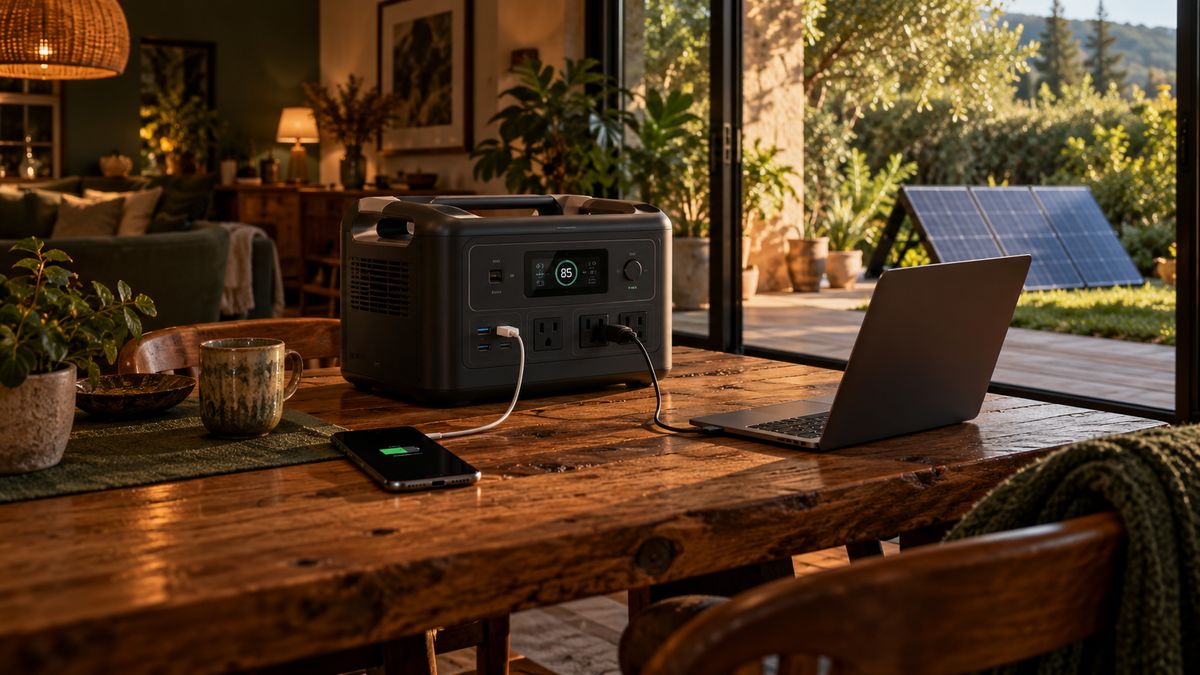
A power outage exposes how dependent our lives are on grid electricity. Solar power with battery storage lets you keep critical systems running — refrigerator, medical equipment, lighting, phone charging, internet — through outages that last hours or days.
This guide covers the full range, from a $1,000 portable power station that handles the basics to a $15,000+ whole-home backup system.
Understanding the Options: Portable vs. Whole-Home
Portable solar power stations are self-contained units: battery storage + inverter + charging circuits in one box, with optional solar panels. They’re plug-and-play, require no installation, and can be used anywhere. Capacity ranges from 300Wh (charge your phone several times) to 5,000+Wh (run a refrigerator for a few days). Cost: $300–$5,000.
Whole-home solar + battery systems are permanently installed, integrate with your electrical panel, and can power your home automatically when the grid goes down. Some systems (like Tesla Powerwall or Enphase IQ) provide seamless backup — your refrigerator never even turns off during an outage. Cost: $10,000–$30,000+ installed.
What most families actually need: A mid-range portable power station (1,000–2,000Wh) with a 100–200W solar panel for recharging covers emergency use cases at $500–1,500 — a fraction of whole-home cost with no installation required.
Step 1: Calculate Your Emergency Power Needs
Before buying anything, figure out what you actually need to run during an outage.
| Device | Wattage | Hours/Day | Daily kWh |
|---|---|---|---|
| Refrigerator | 100–400W (avg ~150) | 24 (runs ~8h) | 1–2 kWh |
| Freezer | 100–300W | 24 (runs ~8h) | 0.5–1.5 kWh |
| LED lighting (5 bulbs) | 50W total | 6 | 0.3 kWh |
| Phone charging | 20W | 2 | 0.04 kWh |
| Laptop | 45–65W | 4 | 0.2–0.26 kWh |
| CPAP machine | 30–60W | 8 | 0.24–0.5 kWh |
| Box fan | 25–75W | 8 | 0.2–0.6 kWh |
Essential emergency loads for most families: Refrigerator + lighting + phone charging + laptop + CPAP if applicable = approximately 2–4 kWh per day.
A 2,000Wh (2kWh) battery holds about 1 day of these essentials. With solar recharging, it’s indefinitely sustainable on sunny days and lasts 2–3 days through a cloudy period.
Portable Power Stations: The Flexible Option
These units have transformed emergency power for most households. No installation, no permits, no complexity.
Good Options by Category
Entry-level backup (600–1,000Wh): $400–700
- Jackery Explorer 1000 Pro (1,002Wh, 1,000W AC output)
- EcoFlow River 2 Pro (768Wh, 800W)
- Bluetti EB70S (716Wh, 800W)
Can run: Phone/laptop charging, LED lighting, CPAP, small fans. Can’t sustain a refrigerator long-term.
Mid-range backup (2,000Wh): $1,000–1,500
- Jackery Explorer 2000 Pro (2,160Wh, 2,200W)
- EcoFlow Delta 2 Max (2,048Wh, 2,400W)
- Bluetti AC200P (2,000Wh, 2,000W)
Can run: Everything above + refrigerator for 1–2 days + router/modem. This is the sweet spot for most families.
Large capacity (3,000–5,000Wh): $2,000–4,000
- EcoFlow Delta Pro (3,600Wh, 3,600W, expandable)
- Bluetti EP500 (5,100Wh, 2,000W)
Can run: Most household essentials for multiple days. Some models can power a 120V circuit directly with an optional adapter.
Matching Solar Panels to Your Power Station
A 200W solar panel generates approximately 1 kWh on a good sunny day (5 hours of effective sun). To fully charge a 2,000Wh battery bank in a day, you’d need 400W of panels under ideal conditions — or accept partial recharging.
Practical rule: Buy 100–200W of solar capacity per 1,000Wh of battery storage if you want reasonable recharging. More is always better.
Foldable panels: EcoFlow, Jackery, and Bluetti all make panels designed to connect directly to their power stations. They’re convenient but pricey per watt. DIY alternatives with separate panels + adapters can cut costs significantly.
Permanent Home Systems
For whole-home backup, the landscape has improved significantly in the past 5 years.
Battery-Only Backup (No Solar)
Tesla Powerwall 3: 13.5 kWh capacity, 11.5 kW continuous output, can back up a whole home. ~$9,000 for the unit, plus $2,000–5,000 installation. Without solar, it charges from the grid at night (off-peak rates) and discharges during outages. A single Powerwall handles essential loads for 1–2 days; two handle more.
Enphase IQ Battery: 10.5 kWh (stackable). Pairs with Enphase microinverters. ~$8,000–12,000 installed.
LG RESU Prime: 9.6–16 kWh. Compatible with multiple inverter brands.
Solar + Battery: The Complete System
A grid-tied solar system with battery backup is the gold standard for energy resilience:
- Powers your home normally from solar during the day
- Exports excess to the grid for credits (net metering)
- Stores excess in batteries for evening and outages
- Grid serves as unlimited backup on cloudy weeks
What it costs:
- 7 kW solar system: ~$14,000–20,000 before incentives
- Powerwall or equivalent: $8,000–13,000
- Total installed: $22,000–33,000 before incentives
Tax incentives: The federal Investment Tax Credit (ITC) covers 30% of system cost for systems installed through 2032. Many states add additional incentives. Check the DSIRE database (dsireusa.org) for your state’s programs.
After the federal credit, a $25,000 system costs $17,500. Many utility companies also offer rebates, further reducing costs.
Payback period: 7–12 years depending on your electricity rate, sun hours, and incentives. With current electricity price inflation, paybacks are shortening.
Priority Equipment for Different Budgets
Budget: Under $1,500 Portable power station (1,000–2,000Wh) + 200W foldable solar panel = emergency essentials covered. Best ROI for most families.
Budget: $3,000–5,000 Larger portable power station (3,000+Wh) + 400W solar panels + EV charger adapter for car-to-home transfer if your car supports it. Covers 2–3 days of whole-house essential loads.
Budget: $10,000–15,000 Battery-only whole-home backup (Powerwall or equivalent). No solar panels needed; charges from grid. Provides seamless automatic backup with no action required during an outage.
Budget: $20,000+ Full solar + storage system. Best long-term ROI, maximum independence, federal tax credit applies.
Tips for Maximizing Solar Output
Panel placement: South-facing panels at the optimal angle for your latitude get the most annual sun. For California (~35°N), that’s about 35° tilt. Even east or west-facing panels produce 80–90% of south-facing output — don’t let imperfect placement stop you.
Shade is the enemy: A shaded panel doesn’t just lose its own output — in traditional string inverters, it can drag down the whole string. If shade is unavoidable, use microinverters (each panel works independently) or power optimizers.
Keep panels clean: Dust, pollen, and bird droppings reduce output. In dry climates especially, an annual cleaning keeps production near nameplate capacity.
Battery temperature: Most lithium batteries operate optimally between 32°F and 100°F. Extreme cold reduces capacity temporarily (you get it back as the battery warms up). Extreme heat over 100°F degrades batteries over time. For permanent installations in extreme climates, choose your battery location accordingly.
Related guides:
More in this category


Rejoindre la communauté
Recevoir nos guides chaque semaine
Des conseils pratiques, des retours terrain, les meilleures ressources — directement dans votre boîte mail.
Rejoindre le Refuge →