Family Water Storage: How Much to Store and How to Do It Right
How to calculate, store, and purify water to stay self-sufficient for several days — the right quantities, the right containers, the right techniques for your family.
Water is simultaneously the most critical item in emergency preparedness and the most neglected. Everyone knows they should store water. Almost nobody does it properly — or at all.
This guide gives you the exact math, the best storage solutions by budget and space, and everything you need to know about purification when your stored supply runs out.
How Much Water Does Your Family Need?
The FEMA baseline: 1 gallon per person per day.
This covers:
- Drinking: about half a gallon (more in heat or if sick)
- Minimal hygiene: tooth brushing, hand washing, face washing
- Basic food preparation: reconstituting freeze-dried meals, washing utensils
This is a minimum. In hot weather, with physical activity, or for nursing mothers, water needs can double.
Practical targets by duration:
| Duration | Per Person | Family of 4 |
|---|---|---|
| 72-hour minimum | 3 gallons | 12 gallons |
| 1 week | 7 gallons | 28 gallons |
| 2 weeks | 14 gallons | 56 gallons |
| 1 month | 30 gallons | 120 gallons |
Add for:
- Each dog or cat: 1 quart/day
- Swimming pool shock treatment or garden use: calculate separately
- Flushing a toilet: 1–2 gallons per flush (prioritize water over flushing)
The Best Water Storage Containers
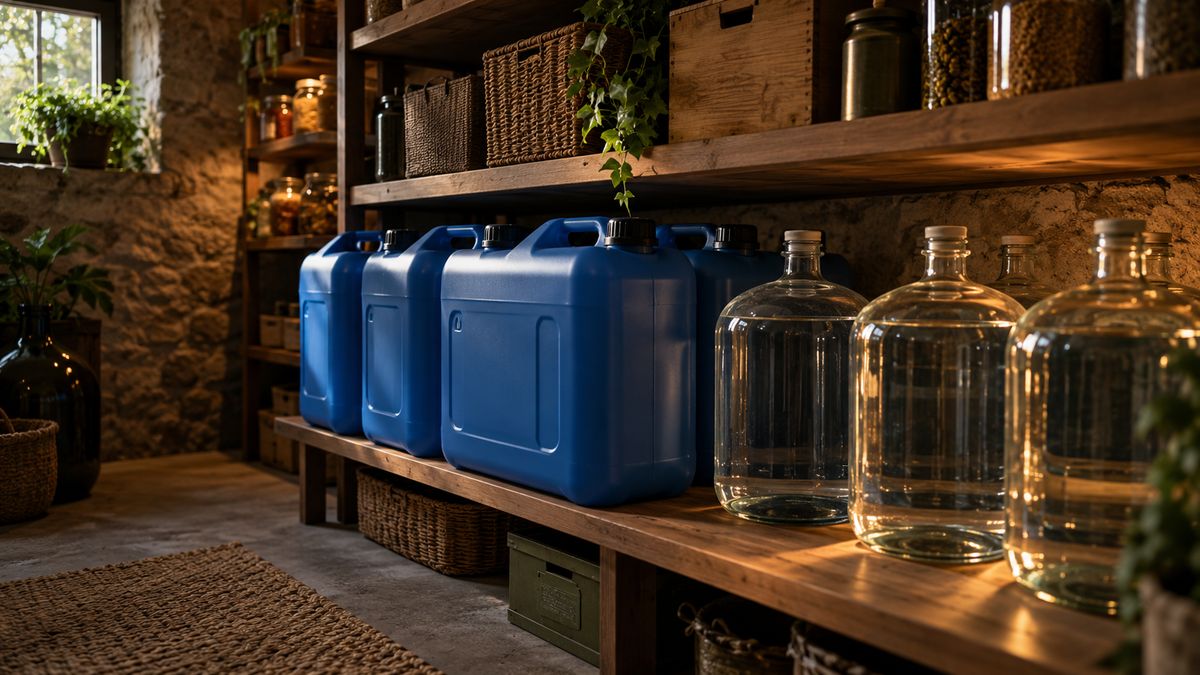
For Most Families: 5-Gallon Food-Grade Jugs ($8–15 each)
The best balance of capacity, portability, and cost. Five gallons weighs about 42 lbs — heavy but movable. Store 6–8 of these and you have a solid 2-week reserve for 2–3 people.
Look for blue HDPE containers specifically marketed for water storage. The color blocks light and indicates food-grade material. Augason Farms, Scepter, and Reliance Products are reliable brands.
For Serious Storage: 55-Gallon Barrel (~$80–120)
The most cost-effective per-gallon option. One barrel holds a 2-month supply for one person or a 2-week supply for a family of 4. The major downside: once placed, it’s not moving. Buy a hand pump ($15–25) to dispense water.
Position it in your basement, garage, or utility room before filling — 55 gallons weighs 460 lbs when full.
For Small Spaces: WaterBOB or AquaPod ($30)
These are bladders designed to fill your bathtub in advance of a known disaster (like a hurricane warning). A standard tub holds 100 gallons. The bladder keeps water clean for up to 4 weeks and dispenses via a hand pump. Not for long-term storage — for immediate use before an event.
For Apartments: 5-Gallon Commercial Bottles
The same bottles used for office water coolers. Food-grade, easy to stack, easy to rotate. Buy empty bottles and fill yourself, or use a water delivery service and simply stockpile full bottles. Stack up to 3 bottles high lying on their side with a rack.
Emergency Fallback: Commercial Bottled Water Cases
A case of 24 sixteen-oz bottles (3 gallons) costs $3–8. Not cost-effective for a 2-week supply, but excellent for the car kit, the go bag, or as quick supplementary supply. Rotate every 2 years per the printed date.
How to Store Water Safely
Location matters:
- Cool (below 70°F ideal) and dark — heat and light degrade plastic over time
- Off the concrete floor (use pallets or shelving) — temperature fluctuations from concrete can leach chemicals
- Away from gasoline, pesticides, paint — plastic absorbs vapors and odors
- Accessible enough to rotate
Never store water in:
- Containers previously used for non-food products
- Thin plastic bags or garbage bags
- Gallon milk jugs — HDPE #1, degrades within a year, not designed for reuse
- Containers that have held bleach, soap, or cleaning products
Filling process:
- Clean container thoroughly with dish soap and rinse completely
- Sanitize: 1 teaspoon unscented household bleach per quart of water, swish, rinse
- Fill with clean tap water to the top (minimize air space)
- Seal tightly
- Label with fill date using permanent marker
- Store in correct location
How to Know If Stored Water Is Safe
Signs that stored water should be purified before drinking:
- Unusual smell (beyond slight plastic odor)
- Visible cloudiness or particles
- Algae growth (green tint, especially if container was exposed to light)
- More than 12 months since filling
When in doubt, purify before drinking. It takes 30 seconds and potentially saves you from severe illness.
Water Purification: Your Safety Net
Purification means you’re never truly “out of water” as long as you have access to any water source — creek, pond, rain barrel, neighbor’s swimming pool.
Boiling (Most Reliable)
Bring water to a rolling boil for 1 minute (3 minutes above 6,500 ft elevation). Kills all bacteria, viruses, and parasites. Requires fuel. Best for water you have time to treat at home.
Limitation: doesn’t remove chemical contamination, heavy metals, or sediment (though sediment can be filtered through a cloth first).
Chlorine Bleach (Cheapest)
Unscented household bleach (5–8% sodium hypochlorite):
- Clear water: 8 drops per gallon (2 drops per quart)
- Cloudy water: 16 drops per gallon (4 drops per quart)
Wait 30 minutes before drinking. If water doesn’t have a slight chlorine smell after 30 minutes, repeat the dose and wait another 15 minutes.
Bleach loses potency over time — replace your emergency bleach supply annually.
Portable Filters (Most Practical)
Sawyer Squeeze ($30–40): Filters up to 100,000 gallons. Remove 99.99999% of bacteria, 99.9999% of protozoa. Does NOT filter viruses (not a concern from most US water sources — rivers, streams, rainwater).
LifeStraw ($20): Same filtration, designed as a personal straw. Great for a go bag, less practical for filling containers for a family.
Katadyn Hiker Pro ($60): Pump filter, faster for filling bottles. Good for base camp or vehicle kit.
Limitation: Filters remove bacteria and protozoa but NOT viruses. For US wilderness water, this is generally fine. For water of unknown urban origin (flood water, contaminated wells), combine with chemical treatment.
UV Purification (SteriPen, ~$80)
Destroys bacteria, viruses, and protozoa using UV light. Fast (90 seconds per liter), effective, no chemical taste. Requires batteries. Not effective in cloudy water (pre-filter first). Good addition to any kit.
Gravity Filter Systems (Best for Home)
The Berkey system ($250–550 depending on size) uses gravity to pull water through ceramic and activated carbon filters. Removes bacteria, viruses, protozoa, heavy metals, chlorine, and many chemicals. No electricity required. Filters 2–10 gallons per hour depending on model.
For a family serious about water self-sufficiency, a Berkey on the counter makes daily filtration easy while providing emergency capacity.
Water Sources in an Emergency
When stored water runs low, in order of safety:
-
Rainwater — cleanest natural source. Collect from roof runoff (may contain bird droppings, pollutants — filter and treat). Direct rainfall is very clean; collect it in clean containers.
-
Moving streams and rivers — filter and treat. Upstream of any human activity is safest.
-
Lakes and ponds — filter and treat. Standing water can contain more parasites.
-
Swimming pool water — typically already treated with chlorine; safe to drink in small quantities immediately. Filtering removes the chlorine taste if you prefer.
-
Hot water heater tank — most households have 30–80 gallons of potable water in the tank right now. Turn off the gas/electricity first, then drain from the bottom spigot.
-
Toilet tank (not bowl) — typically clean water used for flushing. Can be drunk in an emergency.
Never drink:
- Flood water — contains sewage, chemicals, dead animals
- Water from industrial areas — chemical contamination
- Seawater — dangerously increases dehydration
Signs of Dehydration: Know When It’s Serious
Mild dehydration (thirst, darker urine): drink more and slow physical activity.
Moderate dehydration (headache, dizziness, rapid heartbeat, dry mouth): aggressive fluid replacement, rest, seek shade.
Severe dehydration (confusion, no urination for 8+ hours, rapid weak pulse, sunken eyes): medical emergency. If medical care is unavailable, use oral rehydration salts (ORS) — available as Pedialyte, DripDrop, or homemade (1 liter water + 6 teaspoons sugar + ½ teaspoon salt).
Children and elderly dehydrate faster. Prioritize their water intake.
Building Your Storage Incrementally
You don’t have to buy everything at once. A realistic ramp-up:
Month 1 ($50–80): 6 × 5-gallon jugs = 30 gallons. Covers a family of 4 for about a week.
Month 2 ($80–120): Add a 55-gallon drum. Now you have nearly 90 gallons.
Month 3 ($30–60): Add a Sawyer Squeeze filter and purification tablets. Now your stored water is backed by unlimited natural source purification.
Long term ($250): Add a Berkey gravity filter for daily use and emergency capacity.
Water is the first thing to run out in an emergency and the first thing people wish they’d stored more of. The good news: storage is cheap, easy, and mostly a matter of doing it. You don’t need any special skills — you just need containers and the motivation to fill them.
Related guides:
🎬 Watch the video on this topic
Watch on YouTube →
More in this category

Rejoindre la communauté
Recevoir nos guides chaque semaine
Des conseils pratiques, des retours terrain, les meilleures ressources — directement dans votre boîte mail.
Rejoindre le Refuge →