Food Storage Guide: Building Your Family's Emergency Pantry
How to build a 3-month food supply for your family — which foods to choose, how to store them, and how to integrate them into your daily routine.
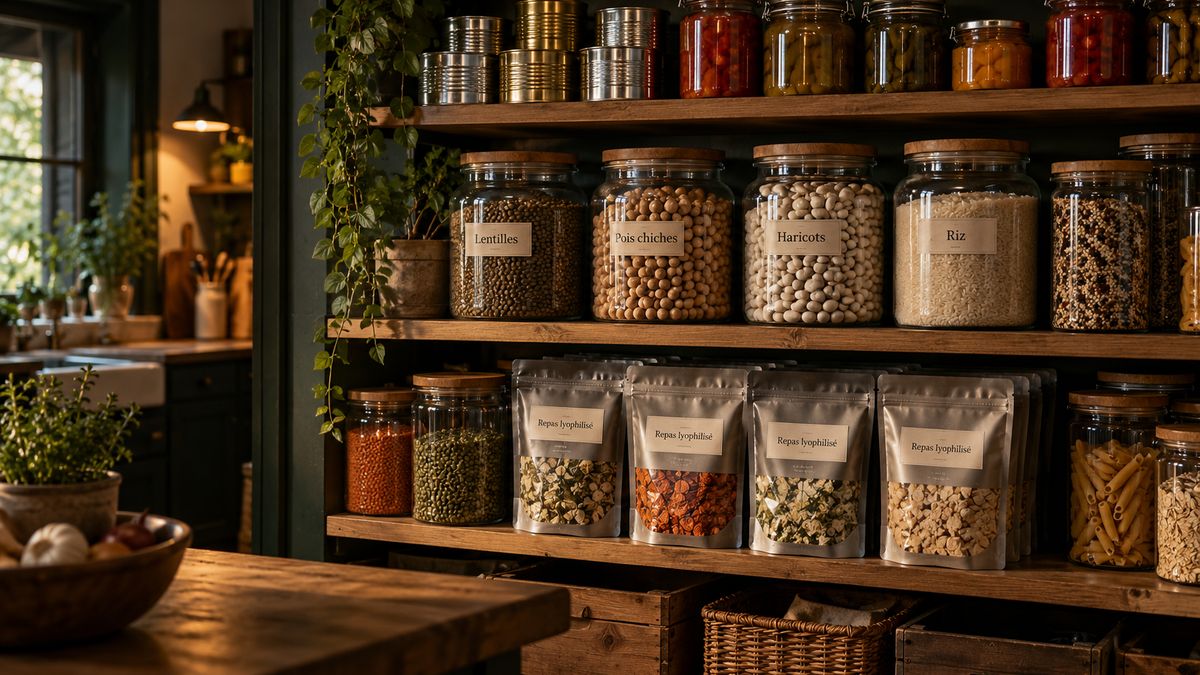
Building a food supply feels overwhelming when you think about it as one big project. It isn’t. It’s just your regular grocery shopping, with intention, over a few months.
This guide tells you exactly what to buy, how much, and how to store it — from a basic 2-week supply to a full 3-month pantry.
Why Store Food?
The reasons are more practical than dramatic. Supply chain disruptions, job loss, natural disasters, illness, snowstorms — any situation where your normal shopping routine is interrupted. During COVID-19, store shelves were empty for weeks. During major hurricanes, resupply can take 2–4 weeks. During a household medical crisis, having food on hand removes one problem from an already-stressful situation.
A 3-month food supply isn’t prepper paranoia — it’s the same logic as having an emergency fund. You hope you don’t need it.
The Foundation: Caloric Math
An adult needs approximately 2,000 calories per day to maintain weight. For 3 months (90 days), that’s 180,000 calories per person.
Practical targets:
| Person | Daily Calories | 2 Weeks | 1 Month | 3 Months |
|---|---|---|---|---|
| Adult | 2,000 | 28,000 | 60,000 | 180,000 |
| Child (5–12) | 1,500 | 21,000 | 45,000 | 135,000 |
| Toddler (1–4) | 1,000 | 14,000 | 30,000 | 90,000 |
This seems like a lot. In terms of real food, it’s manageable. A 50-lb bag of rice contains about 80,000 calories. A family of 4 needs roughly 650,000 calories for 3 months — achievable in a few hundred dollars of strategic purchasing.
The Core Storage Foods
These foods offer the best combination of shelf life, calorie density, cost, and versatility:
Grains and Carbohydrates
White rice — The cornerstone of food storage. White rice stores 25–30 years when sealed. Brown rice has better nutrition but only lasts 6–12 months (oils go rancid). Buy 50-lb bags at Costco, Walmart, or restaurant supply stores. Store in 5-gallon buckets with gamma lids or Mylar bags with oxygen absorbers.
Pasta — 2–3 year shelf life in original packaging, 25+ years sealed in Mylar. Pasta is versatile, calorie-dense (350 calories per 100g dry), and familiar to everyone. Buy in bulk when on sale.
Oats — 30 years sealed. 150 calories per half-cup dry. Great for breakfast, easy to prepare, kids accept it. Buy old-fashioned rolled oats, not instant packets (more expensive per calorie).
All-purpose flour — 1–2 years as-is, 5–10 years sealed with oxygen absorbers. Enables bread, pancakes, thickening soups. Store in cool, dry location.
Cornmeal — Similar to flour. Good for cornbread, polenta, coating.
Proteins
Dried beans and lentils — 25–30 years sealed. Some of the cheapest protein available ($1–2/lb). Black beans, pinto beans, kidney beans, lentils, split peas. Buy dried, not canned (longer shelf life, cheaper per serving, but require soaking and cooking).
Canned proteins — 3–5 year shelf life. Tuna, salmon, chicken, sardines, mackerel. Ready to eat without cooking. Stock a 3-month supply for quick meals.
Peanut butter — 1–2 years unopened. High calorie density (190 calories per 2 tablespoons), protein and fat, kids love it, no cooking required. One of the best single emergency foods available.
Freeze-dried meats — 25 years shelf life. Expensive ($30–80 per #10 can) but provides variety. Mountain House and ReadyWise produce good options.
Canned beans — Shorter shelf life than dried (3–5 years) but no soaking required, ready in minutes. Keep a mix of both.
Fats
Vegetable oil — 1–2 years. Essential for cooking and calorie density (120 calories per tablespoon). Coconut oil stores slightly longer. Olive oil loses quality faster than other oils.
Shortening (Crisco) — 2–3 years sealed. For baking, frying.
Ghee (clarified butter) — 1 year at room temperature, much longer refrigerated or sealed. Superior storage life compared to regular butter.
Sweeteners and Flavorings
Honey — Indefinite shelf life (archaeologists found 3,000-year-old edible honey). Multipurpose: sweetener, preservative, wound treatment. Buy in bulk.
White sugar — Indefinite if kept dry and sealed. Essential for morale and energy.
Salt — Indefinite. Essential for cooking, food preservation, electrolyte balance. Store 10–20 lbs per person.
Spices — 2–4 years. This is underrated. The difference between eating rice and eating seasoned rice over weeks is psychological. Stock: garlic powder, onion powder, black pepper, cumin, chili powder, cinnamon, dried oregano.
Bouillon cubes or powder — 1–2 years. Transform plain water and grain into actual soup. Stock heavily.
Soy sauce, vinegar, hot sauce — 2–4 years. Flavor variety matters enormously during extended use.
Baking Essentials
- Baking powder (1 year) and baking soda (indefinite)
- Yeast (1–2 years sealed, freeze for longer)
- Powdered milk (2–10 years depending on form)
- Powdered eggs (5–10 years sealed)
Comfort and Morale Foods
Don’t underestimate these:
- Coffee, tea, cocoa powder
- Chocolate chips, hard candy
- Crackers, cookies
- Instant pudding and Jell-O
- Dried fruit (raisins, cranberries, apricots)
Children especially need familiar comfort foods under stress.
How Much to Buy: A 3-Month Supply for a Family of 4
| Food | 3-Month Quantity | Approx. Cost |
|---|---|---|
| White rice | 100 lbs | $80–100 |
| Pasta | 50 lbs | $60–80 |
| Oats | 50 lbs | $40–60 |
| Dried beans/lentils | 50 lbs | $60–80 |
| Canned proteins (tuna, chicken) | 100 cans | $80–100 |
| Peanut butter | 15 lbs | $40–50 |
| Vegetable oil | 10 gallons | $60–80 |
| Sugar | 25 lbs | $20–25 |
| Salt | 20 lbs | $10–15 |
| Honey | 10 lbs | $30–40 |
| Canned vegetables/fruit | 100 cans | $80–120 |
| Freeze-dried vegetables (optional) | 10 #10 cans | $100–150 |
| Spices and flavorings | Assortment | $40–60 |
| Total estimate | $650–900 |
This is a reasonable all-in cost for 3 months of basic nutrition for a family of 4. It goes down significantly if you catch sales and buy in bulk.
Storage Methods: Keeping Food Safe for Years
Method 1: Mylar Bags + Oxygen Absorbers + 5-Gallon Buckets
The gold standard for long-term storage.
Process:
- Put a Mylar bag inside a food-grade 5-gallon bucket
- Fill with grain, rice, or beans
- Add appropriate oxygen absorbers (300cc for 1-gallon bags, 2000cc for 5-gallon)
- Seal the Mylar bag with a hot iron or hair straightener across the top
- Seal the bucket with a gamma lid (easy-open) or standard lid
This method can extend shelf life to 25–30 years. Oxygen absorbers prevent insect eggs from hatching and slow oxidation.
Where to buy: Mylar bags, oxygen absorbers, and food-grade buckets are available at Emergency Essentials, Walmart, Amazon, or restaurant supply stores.
Method 2: Original Packaging in Cool, Dark Storage
For items with 1–5 year shelf life, keeping original packaging and monitoring rotation is often sufficient. Store in a cool (below 70°F), dry, dark location. Pantry closets, interior rooms, and basements (if not humid) work well.
Method 3: Glass Jars with Metal Lids
For medium-term storage (1–5 years), quart and half-gallon Mason jars work excellently. Can be vacuum-sealed with a FoodSaver jar attachment to extend shelf life further.
Good for: spices, sugar, salt, flour, dried fruit, pasta, oats.
What Ruins Food Storage
- Moisture — The #1 killer. Keep everything sealed and store containers off concrete floors.
- Heat — Every 10°F increase roughly halves shelf life. Cool storage is critical.
- Light — Degrades nutrients and fats. Store in dark or opaque containers.
- Oxygen — Causes oxidation and allows insect eggs to hatch. Use oxygen absorbers for long-term storage.
- Pests — Mice, pantry moths, weevils. Hard containers stop rodents; oxygen absorbers kill insects.
Building Your Storage in Stages
Stage 1 — 2-Week Supply (~$150, 1 month of shopping):
Add extra items to your regular shopping: an extra bag of rice, extra pasta, extra canned beans, extra peanut butter. Within a month of intentional shopping, you’ll have a 2-week supply.
Stage 2 — 1-Month Supply (~$300, 2–3 months of shopping):
Continue the pattern. Start buying in bulk (Costco, Sam’s Club, restaurant supply). Buy a few 5-gallon buckets and start sealing grain.
Stage 3 — 3-Month Supply (~$650–900, 4–6 months):
You’re now buying 50-lb bags of rice and beans, cases of canned goods when on sale, and building out your Mylar-sealed long-term storage.
The Rotation System: Eating What You Store
The biggest mistake in food storage is building a supply you don’t rotate. Unused food expires; you throw it away and have to rebuy it.
The correct approach: Store what you eat. Eat what you store.
This means:
- Only stockpile foods your family actually eats
- Integrate your storage into daily cooking — the same rice and beans you store are what you cook for dinner
- When you use something, replace it
- Shop sales and add to storage rather than making special “preparedness” purchases
This approach means your storage is always fresh, you never waste anything, and your family is already accustomed to eating the foods in your supply.
Special Dietary Needs
Infants and toddlers:
- Formula: a 3-month supply of formula is an absolute priority if you have an infant
- Baby food pouches: 1–2 year shelf life, easy to rotate
- Note dates carefully — infant nutrition is not negotiable
Gluten intolerance/celiac:
- Rice, oats (certified GF), quinoa, cornmeal, potato flakes
- Many freeze-dried brands offer GF options
Diabetics:
- Prioritize lower-glycemic options: legumes, steel-cut oats, brown rice (shorter shelf life), lentils
- Monitor medication supply separately — insulin storage requires special attention
Allergies:
- Build your supply around what your family can eat, not standard recommendations
- Label everything clearly — in a stressful situation, it’s easy to grab the wrong thing
A 3-month food supply sounds like a lot until you start building it. After a month of intentional shopping, you’ll have a 2-week supply and realize the rest is just continuing the same process. It’s less about spending a lot of money at once and more about being strategic with money you’re already spending.
Related guides:
🎬 Watch the video on this topic

Watch on YouTube →
More in this category


Rejoindre la communauté
Recevoir nos guides chaque semaine
Des conseils pratiques, des retours terrain, les meilleures ressources — directement dans votre boîte mail.
Rejoindre le Refuge →